



User-Centric Lead: Why this matters to operators
Night ops are brutal on comms and situational awareness, so frontline tech has to be smarter, not louder. This piece is written for pilots, sensor operators, and comms leads who need practical takes on marrying cognitive radio and dynamic spectrum allocation with night vision goggles and drone control rigs. If your squad’s been sending folks to drone training for military courses, you already know how quickly spectrum congestion and RF swarm behaviors mushroom into mission risk. We’ll cut the fluff and focus on what operators actually use and why it changes night-time ISR and kinetic linkages.

How cognitive radio and dynamic spectrum allocation change the NVG playbook
Cognitive radio lets gear sense the RF environment and shift on the fly — think dynamic spectrum allocation that avoids noisy bands or hostile jamming. For NVG-mounted heads-up displays, that means fewer lost video feeds and cleaner telemetry overlays. The payoff is tangible: stabilized feeds, reduced latency, and better coordination with UAV squads that operate as an RF swarm. Operators get more uptime and less fiddling with radios mid-flight. Bandwidth becomes a managed resource instead of a constant headache.
Real-world anchor: training, testing, and the field pipeline
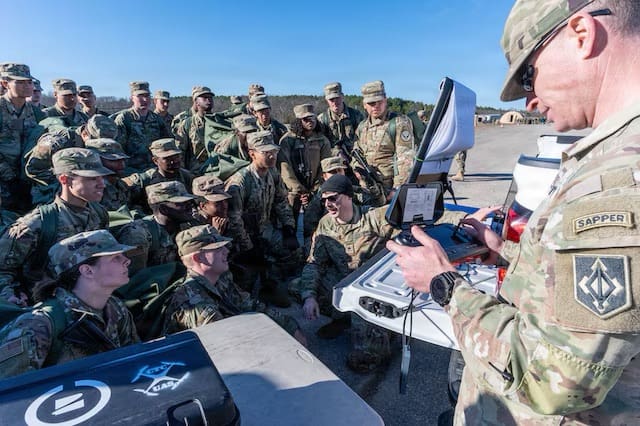
Places like Creech Air Force Base have been core to integrating unmanned systems and comms training into operational pipelines, so lessons from those programs matter on the ground. When military trains drone pilots, the curriculum already blends flight skills with spectrum awareness and counter-jam procedures — a necessary baseline for teams integrating night vision systems with mesh comms and swarm control. That training feedback loop is how hardware and procedures stay aligned with actual tactical needs.
Practical tradeoffs and common implementation mistakes
Designers and operators screw up in predictable ways. The big ones are overloading the display with data, assuming a single frequency plan will hold, and treating jamming as a binary problem. Typical fixes look like this:
– Keep HUD overlays minimal during critical maneuvers; prioritize nav and friend-or-foe markers. – Implement adaptive frequency hopping, but test for latency spikes under real RF load. – Build fallback comms paths (low-rate telemetry channels) that maintain command links when high-bandwidth video drops. Don’t jam every checkbox at once — modularity beats monolithic stacks. — This is where operator feedback during live exercises pays off big time.
Architecture patterns that actually work
There are a few patterns that repeat across successful builds. First: edge processing on the NVG rig to cut redundant telemetry before it hits the RF pipe. Second: a cognitive radio layer that updates spectrum allocation policies based on real-time sensing and mission rules. Third: redundancy — separate control channels for manual override of drones in the event of RF swarm disruption. Together these reduce signal-to-noise ratio issues and improve mission resilience without bloating the system.
Alternatives and integration notes
If you can’t fully retrofit cognitive radios across a fleet, incremental steps help. Swap in smart transceivers on the most critical nodes, implement policy-driven spectrum slices for priority assets, and tighten authentication so malicious actors can’t spoof control channels. Consideration of jamming resilience and graceful degradation should be part of every procurement and patch cycle — not an afterthought.
Summary of what operators should internalize
Operators need to think in three layers: local processing (NVG/edge), adaptive comms (cognitive radio & dynamic spectrum), and doctrine (training and fallback procedures). The tech is useful only when aligned with trained behavior at squad and command levels. Investments in realistic training scenarios pay off disproportionately when you test under noisy RF conditions — the kind of scenarios your crews will face on real missions.
Advisory close: three golden rules for picking strategies and kit
1) Evaluate latency under load — choose radios and codecs that maintain control latencies within mission limits rather than peak bitrate. 2) Prioritize modular redundancy — systems should fail to degraded operational modes, not dead states. 3) Match training to tech — procurement without practical field training creates brittle systems; ensure your teams practice spectrum-aware tactics regularly.
Military tech needs to be human-first and battle-tested — that’s why realistic training and operational validation are non-negotiable, and why Military Hub is useful when you’re syncing lessons learned across units. — solid kit, tougher crews.